




Aluminum Truss


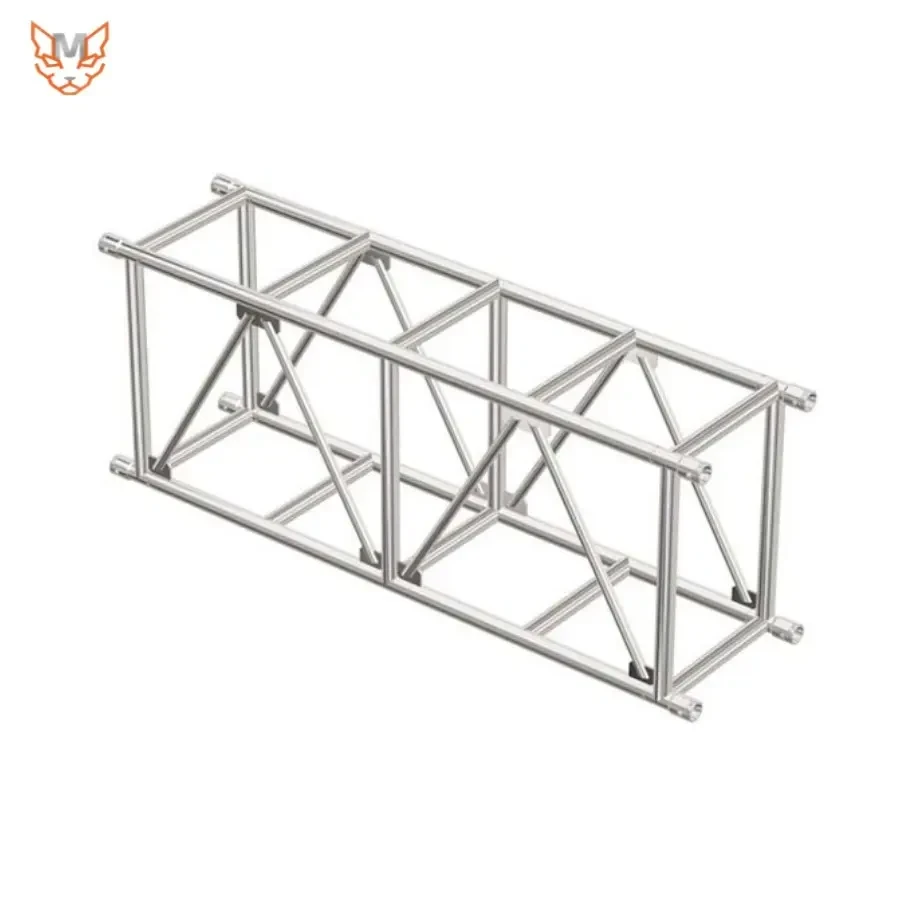
Aluminum truss systems are load-bearing frameworks manufactured from EN AW-6082 T6 extruded aluminum alloy, designed specifically for suspending sound systems, lighting rigs, and LED screens. Their modular structure, connected via conical couplers, minimizes assembly time while ensuring the overall stability and rigidity of the framework. Lightweight yet highly corrosion-resistant, this product line serves as a benchmark structural solution for the performance and events industry.
What Are the Technical and Material Characteristics of Aluminum Truss?
The primary material used in these aluminum truss systems is EN AW-6082 T6 extruded aluminum alloy, fabricated using TIG welding processes certified to the international EN ISO 3834-2 standard by TÜV SÜD. The design features four main chord tubes (Ø50 × 4 mm) combined with diagonal bracing members (Ø30 × 3 mm) to create a network that optimally distributes mechanical stress.
Each truss segment is equipped with EN AW-2011 T8 conical connectors, joined via high-strength steel pins.
| Technical Specification | Declared Standard Value | Basis for Assessment / Applicable Standard |
| Main tube aluminum alloy | EN AW-6082 T6 (Ø50 × 4 mm) | High tensile strength and yield strength |
| Shear-resistant bracing system | Aluminum tube Ø30 × 3 mm; brace angle from 55° | Ensures shear force transmission along the truss body |
| Module connection joint | EN AW-2011 T8 Conical Connector | Safety locking pin (DIN EN ISO 8752) |
| Material density | Approx. 2.7 g/cm³ (one-third that of steel) | Optimizes touring transport costs |
| Welding certification standard | EN ISO 3834-2 certified by TÜV SÜD | Ensures weld penetration and strength |
| Structural design standard | Eurocode 9 (DIN EN 1999-1-1), DIN EN 13814 | Structural safety verification for temporary structures |
Aluminum's low weight cuts the static load exerted on hoist systems and workshop ceiling structures by half. Prefabricated modules available in standard lengths of 1, 2, and 3 meters allow for flexible assembly tailored to any stage area. Its natural oxidation resistance ensures the aluminum surface retains its luster throughout years of outdoor use.
How Are Aluminum Truss Span and Load Capacities Calculated?
Aluminum truss load tables are established in accordance with the DIN EN 1990 standard, featuring a strict deflection limit of L/150 to ensure lighting fixtures remain stable. At a 12-meter span, the box truss system safely supports a center-point load of up to 1,383 kg with a deflection of only 26.8 mm. When the span is extended to 20 meters, the structure maintains stability under a 736 kg point load, fully meeting the requirements for suspending show equipment.
Rigging engineers are required to suspend loads at the connection nodes—where diagonal bracing meets the main chord tubes—to eliminate local bending moments. The use of secondary safety lines keeps the aluminum beams aligned, preserving the safety factor throughout the performance. Load data accounts for the beam's self-weight, enabling technicians to devise precise load suspension plans.
Advantages of Using Aluminum Trusses in the Events Industry
The conical connector system allows technicians to join truss sections rapidly using only a handheld copper hammer.
Its lightweight nature allows the crew to easily carry, position, and dismantle the system with minimal physical effort. Consequently, the stage setup process is significantly faster compared to traditional bolted structures.
The four-sided chord tube design offers numerous mounting points for clamps holding moving head lights, line array speakers, and multi-layered LED screen frames. An elegant silver metallic finish or a matte black powder coating lends a modern aesthetic to the stage. This high aesthetic appeal allows the truss framework to blend seamlessly into the performance environment.
Periodic Technical Inspection Process for Aluminum Trusses
Technicians must thoroughly inspect TIG weld surfaces and the roundness of pin holes before the equipment leaves the warehouse. Cleaning dust and grit from the conical connectors helps maintain the integrity of the metal joints. Periodic checks for beam straightness ensure the structure consistently maintains its rated load-bearing capacity.
Operators should neatly stack aluminum frames onto specialized wheeled racks to prevent chord tube deformation during long-distance transport. Careful storage ensures long-lasting durability and complete peace of mind for every performance.
Evaluating the Investment Value of Aluminum Truss Systems
Aluminum truss systems represent a fixed asset that offers a rapid return on investment for event organizers and theaters.
-
1 Star
0
-
2 Star
0
-
3 Star
0
-
4 Star
0
-
5 Star
0
Filter by keyword
All
Reviews 5 ★
Reviews 4 ★
Reviews 3 ★
Reviews 2 ★
Reviews 1 ★


No reviews yet.