




What Is ESG? A Guide to Corporate Green Transition 2026








The "green booth" is a design solution that utilizes 100% recycled materials combined with energy-efficient equipment. This model enables businesses to cut operating costs by 30% while fully meeting international ESG standards. Commercial corporations are increasingly shifting toward eco-friendly exhibition structures to boost their competitive advantage.
The trend toward sustainable consumption is reshaping the entire modern retail ecosystem. Green marketing strategies implemented through physical spaces help brands build solid trust with investment partners. The following article analyzes four core reasons driving business owners to aggressively invest in green booth designs.

1. What Are ESG Standards? Demystifying the 3 Core Pillars
ESG (Environmental, Social, Governance) criteria serve as a strategic evaluation framework measuring an organization's sustainable development. The United Nations officially introduced this concept in 2004 through the "Who Cares Wins" report. This framework clearly quantifies an enterprise's responsibility toward the surrounding community and environment.
E - Environmental
The Environmental pillar directly evaluates the impact of production and operations on natural ecosystems. Core measurement metrics include greenhouse gas (GHG) emissions, clean energy consumption ratios, and waste management processes. Enterprises actively optimizing these criteria contribute directly toward advancing the Vietnamese Government's Net Zero 2050 commitment.
S - Social
The Social pillar analyzes relationships between the enterprise, its workforce, customers, and local communities. Core metrics encompass workplace safety assurance, cultivating a DEI (Diversity, Equity, Inclusion) work environment, and strict data security. Excelling in these factors helps organizations attract top-tier talent and enhance market brand equity.
G - Governance
The Corporate Governance pillar reflects operational transparency and the executive framework of the Board of Directors. Investment funds frequently assess organizational risk through anti-corruption policies, business ethics codes, and financial reporting integrity. A robust governance system provides optimal shareholder protection against volatile market shifts.
2. Differentiating ESG and CSR: What Sets Them Apart?
Many executives frequently conflate the concepts of CSR (Corporate Social Responsibility) and ESG. However, the operational nature and core objectives of these two systems are fundamentally distinct. The analysis table below delineates the key differences between these strategic directions:
| Evaluation Criteria | Corporate Social Responsibility (CSR) | Sustainability Standards (ESG) |
| Operational Nature | Voluntary, primarily centered around philanthropic initiatives | Mandatory integration into core business strategy |
| Measurement Methodology | Qualitative, based on community sentiment and perception | Quantitative, measured via KPIs and global reporting frameworks |
| Target Audience | Customers, local communities | Shareholders, institutional investors, regulatory authorities |
Leading corporations currently prioritize ESG implementation to fulfill stringent requirements from global financial markets. Enterprises must establish sustainability reports to convert commitments into quantifiable metrics and tangible outcomes.
3. Why ESG Is a "Survival Ticket" for Vietnamese Businesses in 2026
The year 2026 marks a significant turning point in global markets as green standards become a mandatory prerequisite in international trade. Vietnamese enterprises adopting ESG criteria secure a competitive advantage, shielding the organization against international regulatory shifts.
Overcoming Regulatory Barriers & the EU's CBAM Mechanism
The European Union's Carbon Border Adjustment Mechanism (CBAM) imposes rigorous transparency mandates on carbon emissions data for imported goods. Exporters are required to prepare ESG reports to substantiate clean manufacturing credentials. This proactive approach facilitates seamless market entry for Vietnamese goods into high-standard economies.
Unlocking Capital Flows & Benefiting from "Green Credit"
Foreign direct investment (FDI) inflows and global investment funds preferentially allocate capital to ESG-certified projects. Commercial banks are continuously rolling out green financing packages with preferential interest rates. This solution helps relieve financial pressure during corporate expansion.
Optimizing Operating Costs & Elevating Brand Value
Executing an ESG strategy drives substantial savings in electricity, water, and raw material expenses through circular economy models. Sustainable business models also receive overwhelming support from Gen Z consumers and talent. Businesses build profound loyalty across both target markets and internal teams.
4. A 5-Step Roadmap to Building a Systematic ESG Strategy for Enterprises
The green transition process requires a well-structured, measurable action plan grounded in operational reality. Business leaders should follow the 5 core steps below to optimize organizational resources, shaping a standardized implementation pathway for 2026.
Step 1: Baseline Assessment & Priority Identification
Organizations must conduct an exhaustive greenhouse gas inventory and assess current workforce policies. Executive management uses this data to map a materiality matrix, pinpointing urgent priorities for action.
Step 2: Defining Target Metrics (KPIs) and a Strategic Roadmap
Executive management must establish clear, quantitative metrics (KPIs) for each developmental phase. The Net Zero 2050 roadmap should be broken down into actionable quarterly and annual targets.
Step 3: Integrating Digital Technology for Data Measurement
Implementing specialized ESG software automates the collection and analysis of carbon emissions data. Technology solutions ensure accuracy and transparency while eliminating thousands of manual working hours.
Step 4: Embedding ESG into Corporate Culture & Operating Procedures
ESG standards must thoroughly permeate internal workplace culture and daily operations across every department. Mid-level managers play an instrumental role in communicating purpose and driving team execution toward green commitments.
Step 5: Publishing ESG Reports Aligned with Global Standards (GRI, SASB)
The final step involves synthesizing data into comprehensive ESG disclosures adhering to global frameworks such as GRI or SASB. This document acts as verified certification, validating authentic capability before investment committees.
5. Warning Against "Greenwashing" Traps in ESG Practice
Greenwashing refers to the deceptive practice where an enterprise exaggerates its environmental protection credentials beyond actual capability. Many organizations launch extensive PR campaigns while lacking verifiable data metrics to back up claims. Such conduct severely impairs brand reputation and readily triggers legal scrutiny.
To steer clear of greenwashing traps, organizations must maintain complete transparency across all publicly disclosed metrics. Businesses should partner with independent auditing entities to verify sustainability reporting integrity. Interested readers can explore specialized advisory programs to learn how enterprises navigate and avoid greenwashing pitfalls.
6. Exemplary ESG Pioneers in Vietnam and Globally
Market practicalities have highlighted remarkable milestones achieved by early adopters embedding sustainable standards into their core business models. These successful case studies provide valuable benchmarks for other market participants. Here are three leading representatives globally and within Vietnam:
- Patagonia: This global outdoor apparel brand commits all business profits to fund environmental and ecological conservation projects.
- Vinamilk: Vietnam's premier dairy enterprise operates manufacturing facilities and dairy farms certified carbon neutral (Net Zero) under the PAS 2060 standard.
- FPT: The leading technology corporation operates green data center facilities and delivers automated greenhouse gas accounting solutions.
7. Frequently Asked Questions (FAQ) on ESG Standards
Strategic ESG advisory services frequently encounter key inquiries from enterprise owners and managing executives. Below are comprehensive answers addressing core questions surrounding this green transition journey.
Do SMEs (Small and Medium Enterprises) Need to Produce ESG Reports?
SMEs are required to prepare ESG reports when entering supply chains of multinational corporations. Major partners mandate supplier compliance with environmental and sustainability guidelines prior to contractual engagement.
How Long Does It Take for a Business to Attain ESG Certification?
Completing data integration and securing ESG certifications typically takes 6 to 12 months, depending on organizational scale. Close collaboration with strategic ESG consultants optimizes assessment and verification timelines.
Is ESG Reporting Legally Mandatory in Vietnam?
Circular 96/2020/TT-BTC mandates that public companies listed on the stock exchange disclose annual sustainability reports. Scope of application is progressively extending across private sectors to align with national sustainable development agendas.
What Is the Cost of Implementing an ESG Assessment System?
Investment capital varies based on workforce size and operational complexity. Initial expenditures are rapidly recouped through efficiency gains, energy savings, and preferential financing mechanisms.
8. Conclusion
ESG criteria serve as a decisive benchmark for organizational competitiveness across global capital markets in 2026. A sustainable strategy drives capital attraction, cost optimization, and enduring brand equity.
Business leaders should act today, starting with the smallest incremental improvements across operating workflows. Our advisory team stands ready to assist executives in establishing world-class, internationally compliant ESG reporting frameworks.

-
1 Star
0
-
2 Star
0
-
3 Star
0
-
4 Star
0
-
5 Star
0
Filter by keyword
All
Reviews 5 ★
Reviews 4 ★
Reviews 3 ★
Reviews 2 ★
Reviews 1 ★
Comment List
Related Articles


19/10/2026

77
How Much Does It Cost to Participate in Trade Fairs and Exhibitions in 2026?
Exhibition participation costs in 2026 range from 20 million VND for a standard 9m² booth to hundreds of millions of VND for a custom raw space booth. The financial budget estimate includes space rental rates, booth construction quotations, venue management fees, and accompanying operational expenditures. Marketing Directors must accurately measure each item to ensure the highest return on investment.

19/10/2026
91
Schedule of the 10 Largest Trade Fairs and Exhibitions in Vietnam in 2026
The schedule of Vietnam is largest trade exhibitions in 2026 gathers key B2B events such as Vietnam Expo, Vietbuild, and HawaExpo, hosted at SECC and VEC. This list provides accurate dates and venues, helping manufacturing and import-export enterprises plan booth registration 3 to 6 months in advance. Early preparation ensures brands secure prime display locations and optimize trade show booth construction budgets.

19/10/2026
94
Latest 2026 Schedule of Trade Fairs and Exhibitions in Vietnam (SECC, VEC)
The 2026 Vietnam Exhibition and Trade Fair Schedule compiles comprehensive data on major B2B commercial events held at the SECC and VEC exhibition centers. This summary provides precise event dates, helping businesses proactively plan partner outreach. Mastering these trade promotion milestones provides corporate leadership with a solid foundation to book spaces and plan highly effective 2026 exhibition booth designs.

08/10/2026
188
Why Do Single-Use Booths Generate So Much Waste?
Single-use exhibition booths generate a massive volume of waste due to bonded plywood structures reinforced with nails and glue that must be demolished after just a few days of display. In 2019, Informa Group published data confirming that this raw construction model accounts for up to 80% of total waste at global B2B events. Businesses need to transition to reusable modular booth designs to optimize up to 70% of their budget and fully comply with green ESG standards.
08/10/2026
168
10 Ways to Reduce Single-Use Materials in Booth Construction
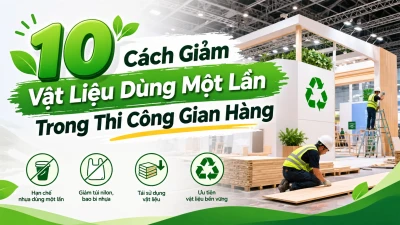
Businesses optimize their sustainable exhibition booth construction budgets by applying 10 Better Stands-compliant modular design solutions. The Octanorm aluminum frame system combined with SEG fabric walls and Click-lock SPC flooring helps reduce post-event material waste by up to 70%. This smart assembly solution provides flexible area reconfigurability, maximizing financial efficiency for B2B marketing departments.
08/10/2026
171
Reusing Booths After the Exhibition: Which Components Can Be Reused?
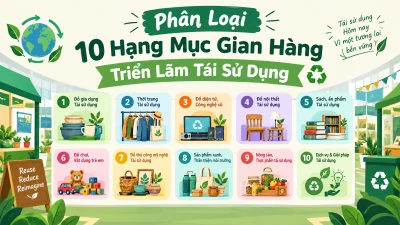
Modular booths allow business owners to reuse up to 95% of structural components and materials after an event. Core items suitable for circular rotation include extruded aluminum frame systems, plug-and-play lighting equipment, and modular flooring. The Better Stands assessment framework requires managers to clearly classify each component group to establish comprehensive, long-term booth storage solutions.

08/10/2026
178
Designing Reusable Exhibition Booths: Key Considerations
Modular booth design utilizing an aluminum profile framing system combined with tension fabric helps businesses save up to 50% of their budget across multiple exhibitions. This model replaces traditional carpentry with mechanical lock connectors, allowing precise area adjustments from 18m² up to 54m². Below is a detailed analysis of technical specifications and the Total Cost of Ownership (TCO) optimization strategy for brands attending annual trade shows.

05/10/2026
164
Construction of Eco-Friendly Exhibition Booths: Sustainable Materials & Solutions
Constructing eco-friendly exhibition booths involves using reusable modular structures to meet Informa Markets Better Stand standards while optimizing event budgets by 40%. This sustainable model combines extruded aluminum alloys with reclaimed wood, creating a sophisticated image for businesses at major venues like the SECC. The information below outlines the material specifications and optimal construction solutions tailored to your brand.

04/10/2026
148
The Trend of Eco-friendly Booths in the Current Exhibition Industry
The "Green Booth" trend of 2026 is emerging as a key shopping solution, focusing on the distribution of high-energy-efficiency appliances and ESG-compliant products. This eco-friendly model enables households to directly cut electricity costs by 40% while creating market expansion opportunities for sustainable manufacturers.

04/10/2026
143
Why Do Businesses Prioritize Investing in Green Booths?
The "green booth" is a design solution that utilizes 100% recycled materials combined with energy-efficient equipment. This model enables businesses to cut operating costs by 30% while fully meeting international ESG standards. Commercial corporations are increasingly shifting toward eco-friendly exhibition structures to boost their competitive advantage. The trend toward sustainable consumption is reshaping the entire modern retail ecosystem. Green marketing strategies implemented through physical spaces help brands build solid trust with investment partners. The following article analyzes four core reasons driving business owners to aggressively invest in green booth designs.





No reviews yet.